Tuesday 22 / September / 2026
Duqm: The Wilayat of Duqm stands as one of the richest regions in the Sultanate of Oman in terms of archaeological heritage, with more than 1,000 documented sites reflecting deep-rooted human settlement and cultural exchange between southern and northern Oman.
Among the most exceptional locations is Wadi Nafun, home to rock art, shell settlement mounds, graves, and mysterious three-stone monuments. The site once served as a hub for social gathering and mobility.
Dr. Ali bin Hamoud Al Mahrouqi, Director of the Department of Archaeological Surveys and Excavations at the Ministry of Heritage and Tourism, told the Oman News Agency that evidence indicates the first human settlement in Duqm dates back approximately 100,000 years. In 2023, stone tools from the Middle Stone Age were discovered for the first time in Wadi Baw, west of Duqm, significantly enhancing understanding of early human migrations from Africa to the Arabian Peninsula and Eurasia.
He added that the rock shelter in Wadi Sai functioned as a hunting camp and stone-weapon workshop. Excavations uncovered 32 flint arrowheads and several hearths dating between 1,000 and 7,500 years ago. Wadi Sai is the first site in Oman to document the transitional phase from the Late Paleolithic to the Neolithic period.
A particularly remarkable discovery is the massive Neolithic grave in Nafun, overlooking the valley, containing the remains of more than 50 individuals. Radiocarbon analysis indicates burials occurred between 6,600 and 7,000 years ago, making it the oldest known large-scale funerary structure in southern Arabia.
The Nafun shell mound represents a unique coastal settlement characterized by extensive shell waste piles. Around 3,000 years ago, it likely served as a temporary port where sailors obtained fresh water and exchanged goods with inland communities of northern Oman.
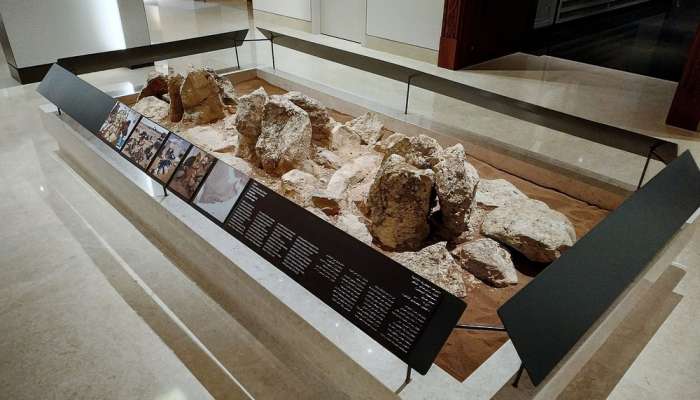
Duqm is also known for its enigmatic three-stone monuments dating back about 2,000 years. Spread across coastal highlands from eastern Yemen to northern Oman, these structures were used by Bedouins for various purposes. In 2018, one endangered monument was relocated to permanent display at the National Museum in Muscat.
Buthaina bint Rashid Al-Ghafeeli, archaeologist at the Ministry of Heritage and Tourism, highlighted the significance of the Al-Safiya area in Wadi Nafun, which contains over 500 rock drawings on 62 limestone outcrops. These include depictions of camels, hunters, horses, turtles, squid, and marine life, alongside approximately 300 inscriptions in ancient South Arabian script dating from 7,000 to 1,000 years ago.
One distinctive rock features marine imagery, including whales—specifically sperm whales—and 13 sea turtles, a rare subject in Omani rock art. Most carvings date to the Late Iron Age, during the Samad period (3rd century BC to 3rd century AD), when South Arabian alphabets began to be used.
Dr. Alzbeta Danielsova of the Institute of Archaeology of the Czech Academy of Sciences explained that excavations began in 2020, with focus shifting to Neolithic tombs after initial coastal surveys. Work resumed in 2022 following the pandemic, and the mission is currently in its sixth season, with two additional seasons planned to complete excavation of the burial complex.
She described the site as unique in the southeastern Arabian Peninsula. Built with large standing limestone slabs arranged in circular formations, the monumental tombs differ from other burial sites such as Ras al-Hamra, Ras al-Jinz, and Jebel Buways 18, which lack comparable funerary architecture.
Radiocarbon dating shows the site was used for at least 300 years by different groups. Isotopic analysis suggests some individuals came from distant regions, reflecting mobility and shared ritual practices among Neolithic communities.
Stone tool studies reveal wide-ranging movement across Oman, the Gulf, and the Arabian Sea, suggesting maritime knowledge and possible boat use. Shark teeth discovered at the site may have been collected from open waters, reinforcing this theory.
The tombs were constructed using locally sourced limestone slabs placed in shallow trenches and supported by outer circular stone walls. Standing approximately 1.2 meters high, the structures were likely open from the top, exposed to seasonal monsoon winds and rain.
Human remains indicate bodies were wrapped in mats or fabric before burial, raising the possibility that some individuals died elsewhere and were transported to this shared sacred site—highlighting the profound ritual and social cohesion of Neolithic societies in Duqm.