Friday 09 / October / 2026
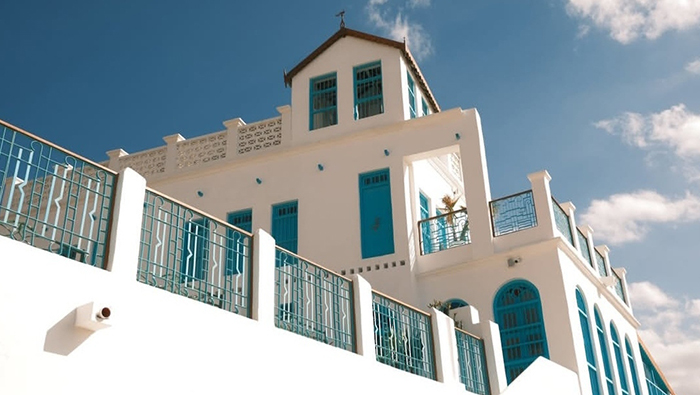
Muttrah: Al Sharqi House or “The Eastern House” stands as one of the most illustrious historic residences in the Wilayat of Muttrah, Muscat Governorate—a venerable structure that for decades served as a gracious waypoint for merchants and visitors arriving in this storied port city, long celebrated for its maritime enterprise and commercial vibrancy.
Following meticulous restoration undertaken pursuant to an agreement between the Ministry of Heritage and Tourism and Jebel Al Akhdar Hotels and Resorts, the Al Sharqi House now reclaims its rightful place in Muttrah's collective memory and urban identity. The project safeguards both its architectural integrity and its strategic proximity to Muttrah Fort, ensuring this nearly 131-year-old edifice endures as a touchstone of the city's built heritage.
Eng. Hamida Sulaiman Al Azri, Projects Director and Chief Architect at Jebel Al Akhdar Hotels and Resorts, elucidates the house's origins: it derives its name from its geographical position east of Muttrah, with construction dating to approximately 1895. The commission came from merchant Said bin Rashid Al Zakwani, scion of a distinguished Omani trading family of that era, whose commercial enterprise centered upon exporting dried dates through the harbour known as "Al-Fardha." His selection of this site—chosen for its proximity to the port—aligned perfectly with his mercantile operations, facilitating both storage and export logistics. He dedicated portions of the ground floor to warehousing goods. The house assumed its present form upon completion by Talib bin Mohammed Al Zakwani in 1960.
During its heyday, she noted, the residence attracted dignitaries and merchants from across the Sultanate of Oman's governorates, particularly from A’Dakhiliyah, Al Batinah, and A’Sharqiyah. Morning gatherings convened in a corner known as "Al-Sabah," where news was exchanged before proceeding to the market. In the early years of Oman's blessed renaissance, it also served as headquarters for the then Ministry of Lands.
The Al Sharqi House distinguishes itself through architectural character of exceptional distinctiveness, reflecting the diverse cultural currents that shaped historic Muttrah. The residence synthesizes elements derived from traditional Muttrah dwellings of that epoch with features evincing East African influence—a testament to Muttrah's nature as a vibrant commercial port historically connected to trade and migration networks across the Indian Ocean. Certain decorative details reveal Persian and Indian influences, bearing witness to the rich cultural exchange that flourished in the region during that period.
Rafia Ibrahim Al Bahlani, Architect and Technical Implementation Lead at Jebel Al Akhdar Hotels and Resorts, elaborates upon the restoration philosophy: the team prioritized preserving authentic architectural characteristics without compromising the site's essential identity. All windows and doors underwent meticulous restoration utilizing original components wherever feasible. Replacement pieces, identical to the originals, were crafted only when elements had deteriorated beyond practicable reuse. Interior spatial divisions were maintained according to their historical configuration, while select areas were adaptively repurposed to accommodate the house's new role as a cultural destination. The restoration project achieves equilibrium between preserving historic authenticity and offering visitors a meaningful cultural and architectural experience.
She highlighted a particularly notable aspect of the Al Sharqi House's design: its remarkable adaptation to maritime climatic conditions. A central courtyard facilitates natural ventilation while providing shaded gathering space. The deliberate arrangement of balconies and openings allows sea breezes to penetrate and circulate through interior spaces, contributing to passive cooling without mechanical intervention. These architectural solutions reflect profound understanding of local climatic particularities and demonstrate how traditional designers employed elemental design features to create comfortable living environments long before modern cooling technologies.
She added that today, the house accommodates four boutique hotel guest rooms, a souvenir shop, a restaurant, and a multipurpose room—offering an experience that seamlessly merges hospitality with heritage. It also contains Muttrah's first well-constructed upon a hill, now adaptively preserved to honour its historical significance and highlight its importance within the house's ensemble, ensuring this architectural jewel continues to enchant visitors for generations to come.