Thursday 04 / June / 2026
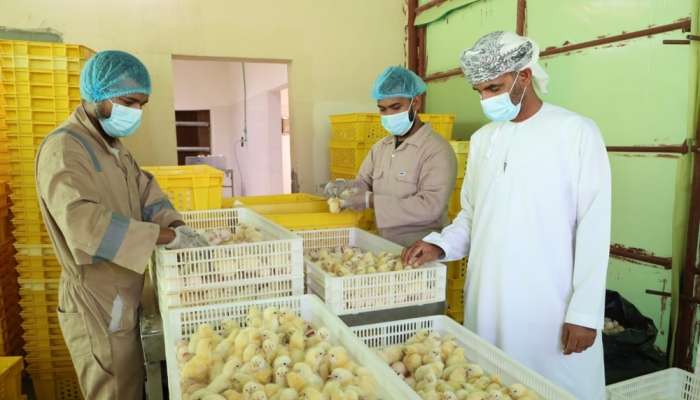
Ibri--- An ambitious young Omani man continues his journey in the livestock production sector, investing his passion and ability to turn available potential into pioneering projects. With unwavering determination and a forward‑looking vision, he is contributing to the national economy and food security, working towards self‑sufficiency and meeting local market needs.
Badr bin Saleem Al Kalbani’s “Murtafaat Al Najeed” “Al Najeed Heights” project has emerged as the first chick‑producing hatchery in the Wilayat of Ibri, A’Dhahirah Governorate. What began as a private investment has become a national symbol of collaboration between youth initiatives and government plans to localise the poultry sector and improve supply chains in Oman.
Al Kalbani said the idea grew from a clear passion for livestock production and a desire to invest available environmental resources for sustainable income. The goal was never a passing experiment, he explained, but a vision to build an integrated project serving the community.
The first step came in 2003, when he owned a small farm in Ibri and looked for an additional source of income. After studying agriculture and livestock, he settled on hatching — a rare project at the time. He started with a simple incubator capable of holding just 350 eggs, limited to local chickens. Over the years, he expanded gradually, and in 2009 he established a small hatchery that marked his real entry into the commercial market.
In 2024, Al Kalbani opened a new hatchery with a larger capacity, equipped with high‑quality incubators, strengthening his position as the first chick producer in A’Dhahirah Governorate and continuing his mission to support food security and meet local demand.
The model hatchery includes specialised chambers, Al Kalbani explained. Eggs arrive in a cooling room, then move to a sorting chamber where they are placed in special trays. The trays go to an incubation chamber for 18 days. After that, the eggs are transferred to a hatching chamber with modern machines, where hatching takes three days. Finally, the chicks are gathered in a collection chamber and placed in boxes for delivery to customers and farms.
The hatchery’s current capacity is about 700,000 chicks a year, while actual production so far has reached about 450,000 chicks annually, he said.
Most of the production is marketed locally across Oman, including the governorates of A’Dhahirah, A’Dakhiliyah, Al Batinah and A’Sharqiyah, reflecting the project’s vital role in supporting local markets and strengthening the food security system, Badr Al Kalbani said.
The experience, despite its challenges, was an important milestone for honing expertise and enhancing capabilities, and the success achieved today is the fruit of perseverance and continuous learning, he added.
The goal is an integrated broiler production cycle — from egg to chick to rearing to slaughter through modern abattoirs — achieving full integration in the production chain and strengthening food security, he said.
Al Kalbani praised the vital role of the Directorate General of Agriculture and Water Resources in A’Dhahirah Governorate and the Municipality of Ibri in supporting animal welfare, saying their help has directly raised production efficiency.
Intensive awareness seminars and vaccination programmes have boosted knowledge among breeders, along with the selection of strains with high growth rates and natural adaptability to the local environment, giving the product exceptional quality in the market.
Work follows strict sterilisation and biosecurity systems at all hatching stages, ensuring chicks are disease‑free and allowing breeders to receive “fresh chicks” at peak vitality and activity. Strict health standards have also reduced mortality and increased poultry production efficiency, strengthening local consumer confidence and confirming the project as an important contributor to national food security.
Eng. Mohammed bin Ali Al Shandoudi, Director of the Animal Wealth Department at the same directorate, told Oman News Agency (ONA) that the project is a strategic addition to the national drive for food security. Oman has made significant progress in the sector, with self‑sufficiency for white meat reaching about 62 percent. Local hatching projects such as “Murtafaat Al Najeed” are a fundamental pillar for raising that rate and narrowing the import gap, ensuring market stability and the availability of high‑quality local products.
The Ministry of Agriculture, Fisheries and Water Resources, through its relevant directorate, places the support of entrepreneurs in the poultry sector at the top of its priorities, he explained. A package of facilitations is provided, including specialised technical guidance and regular follow‑up of production stages, to ensure hatcheries comply with standard specifications and veterinary health standards.
The directorate is committed to its role as a success partner, offering the necessary consultations to help young investors overcome operational obstacles and ensure efficient, uninterrupted production, he added.
On the economic and social impact of the “Murtafaat Al Najeed” project, Al Shandoudi said the project makes a tangible contribution to revitalising the agricultural and livestock sector in the governorate, while also generating direct and indirect jobs for Omani youth. The economic activity extends beyond the hatchery itself to breeders and small farms in the region, which now have a nearby, reliable source of chicks. This reduces their logistical costs and encourages them to expand production.