Friday 24 / July / 2026
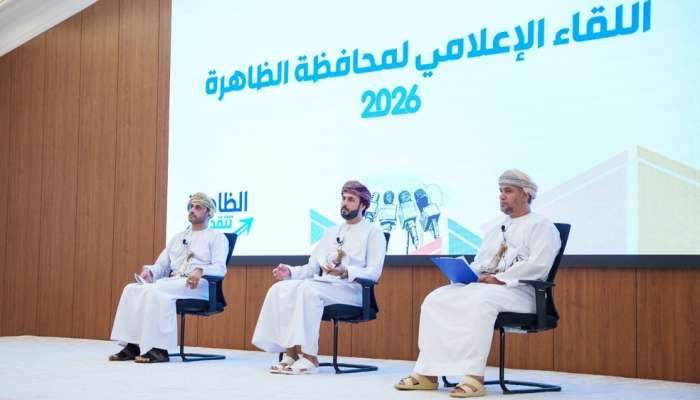
Ibri: Al Dhahirah Governorate organised on Tuesday a press meeting during which the most prominent developmental achievements and future projects of the governorate were reviewed, with wide participation that included a number of officials from government entities and media representatives.
The meeting witnessed the presentation of three main pillars: the first on the plans and vision of the governorate during the Eleventh Five-Year Plan (2026–2030), while the second pillar reviewed the executive status of the governorate’s projects during the Tenth Five-Year Plan, and the third addressed municipal projects in the governorate.
The first pillar was highlighted by Taher Mabkhout Al Junaibi, Governor of Al Dhahirah, who emphasised the importance of utilising the governorate’s competitive advantage, with a primary focus on food and water security projects, tourism and archaeological sites, logistics, renewable energy, mining and industry, in addition to supporting digital transformation, which would support economic and investment activity in the governorate and provide business opportunities for small and medium enterprises (SMEs) and job opportunities for job seekers.
He pointed out that the most prominent strategic projects implemented and under implementation during the Tenth Five-Year Plan reached a total value of more than OMR770 million, including the expansion of service networks (water, electricity, telecommunications) at OMR235 million, solar energy projects in Ibri at OMR270 million, Ibri Industrial City (Madayn) at OMR25 million, the Integrated Economic Zone at the Empty Quarter border crossing (Phase 1) at OMR122 million, in addition to mining projects (Mazoon Copper Project in Yanqul) at OMR115 million, and food security projects at OMR40 million.
Al Junaibi also reviewed the projects approved in the Al Dhahirah Governorate plan for the year 2026 within the Eleventh Five-Year Plan, including the Ibri Public Park (Phase 2), the establishment of the Science and Innovation Center, the development of the commercial area in Al Dariz in the Wilayat of Ibri, the Al Nahda neighborhood walkway (Phase 2), paving roads and parking lots for the viewpoints of the Wilayats of Yanqul and Dhank, paving roads for residential and industrial layouts, energy-saving lighting projects, developing the Ibri waterfront “Our Waterfront”, and projects for developing and beautifying the centers of the wilayats, public parks, and children’s playgrounds, in addition to the Ibri Central Slaughterhouse project.
For his part, Eng. Nuseir Ali Al Siyabi, Director General of A’Dhahirah Municipality, presented the second pillar on the executive status of the governorate’s projects during the Tenth Five-Year Plan, explaining that the total number of projects in this pillar reached 182 projects (159 implemented and 23 under implementation), with an overall completion rate of 89%, and a total value of OMR 40 million, to which the private sector contributed more than OMR 3 million.
The meeting also revealed that the municipal projects were distributed across three main pillars: infrastructure projects, development, parks, and health walkways projects, and service projects. Infrastructure projects included 88 projects worth more than OMR 23 million, with a completion rate of 88%, which included paving internal roads, paving roads for industrial layouts, road maintenance, and energy-saving lighting projects.
Meanwhile, development, parks, and health walkways projects included 22 projects worth more than OMR 11 million, with a completion rate of 89%, most notably the Ibri Public Park (Phase 1), the viewpoints of Yanqul and Dhank, the walkway of the Niyabat of Hamra Al Duru, the Al Aqbah neighborhood walkway, the Dhank walkway, the Al Waqbah walkway, and the Al Nahda neighborhood walkway.
Regarding service projects, they included 75 projects to the tune of more than OMR 1.5 million, with a completion rate of 89%, which included a car show arena, the development of the Friday Market in Yanqul, the protection of property from floods, the events square in Ibri, and rainwater drainage in the governorate’s wilayats.