Saturday 10 / October / 2026
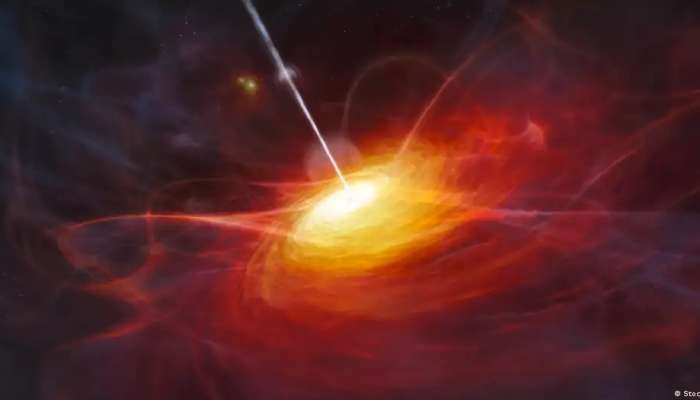
Frankfurt: Quasars emit primordial light. They are far, far away, both in terms of time and distance. They are easy to confuse with other celestial sources of light, such as stars that are closer to Earth.
But when we do detect them, they tell astronomers a lot about the earliest moments of the universe, knowledge that helps us learn more about our place in it.
The European Space Agency's Euclid space-based telescope launched in 2024 to map the universe. ESA has now released images of two of the most ancient quasars ever located.
They are just two out of a crop of 31 quasars that hark back to a time when the universe was a mere 670 million years old. That's within the first 5% of its current age.
"Before, we could only find a handful of the very brightest ancient quasars, but Euclid lets us search far more efficiently across huge areas of [the night sky] to capture much fainter light. It's a unique tool for quasar hunting," says Daming Yang, the lead author of a study about the new findings, published July 6, 2026.
Hunting for quasars: An archaeological dig of the universe
Redshift is sometimes compared to the Doppler Effect in sound — the idea that when you move towards or away from a sound, such as an ambulance siren, it changes in pitch. When it's moving toward you, you hear it at a higher pitch or frequency, and as you move away from it, you hear the same sound at a lower pitch or frequency. Higher and lower pitches are the same as bass sounds and treble sounds in music.
The difference is that redshift relates to light rather than sound. Think back to these new quasars from the earliest moments of the universe — they are far from us. Their wavelengths are longer, shifted into the red zone of the spectrum. Hence, redshifted.
Unfortunately, there is no handy visible equivalent from everyday life to illustrate a redshift.
But what's really fascinating in terms of these quasars is that, while we and they may have remained at the same relative location over time, the light from those quasars is stretched, or redshifted, because the universe is expanding.
"This finding more than doubles the number of quasars we know of that are so ancient," says Antonio La Marca, an ESA Research Fellow in the Euclid team.
It took astronomers more than a decade to discover the first 10 quasars with redshifts of 7 or higher. The Euclid telescope has discovered more than that in a single year of operation.