Tuesday 01 / September / 2026
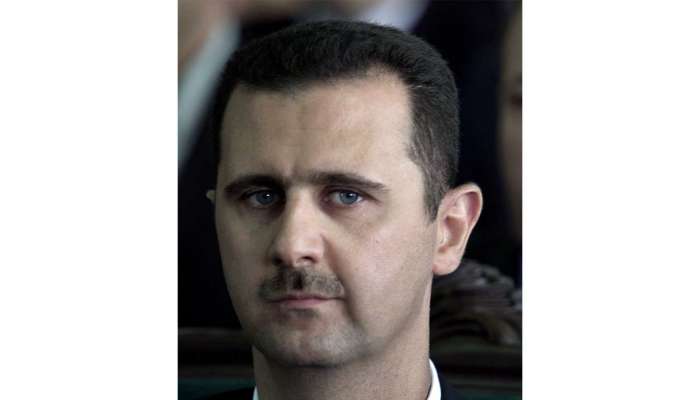
Damascus: Former Syrian President Bashar al-Assad was sentenced to death in absentia by a criminal court in Damascus on Tuesday, after being convicted of premeditated murder, while Atef Najib, former head of political security in southern Syria's Deraa province, was also sentenced to death after being found guilty of premeditated murder and torture, Al Jazeera reported.
According to the Times of Israel, the Damascus court's ruling marks the first death sentence against Assad by Syria's transitional authorities, which began proceedings this year against figures associated with his former government, both in person and in absentia.
According to court convictions, Assad was convicted over charges linked to the 13-year civil war, with the case also described as involving "war crimes" and "crimes against humanity".
Assad fled Syria with his family in December 2024 as opposition forces led by Hayat Tahrir al-Sham (HTS) advanced towards Damascus. He was subsequently granted asylum in Russia.
Assad was ousted after HTS-led opposition forces launched an offensive from the northwestern province of Idlib and reached Damascus in the early hours of December 8, 2024, bringing an end to more than five decades of rule by the Assad family.
Ahmed al-Sharaa, whose forces led the offensive that removed Assad, subsequently became the head of Syria's transitional authorities, after which he pledged to hold accountable those responsible for bloodshed and atrocities committed during the Assad era.
Al-Sharaa also became the first Syrian leader in nearly 60 years to address the UN General Assembly, where he called for the complete lifting of sanctions imposed on Syria.
The Trump administration later revoked the foreign terrorist organisation designation of Hay'at Tahrir al-Sham (HTS), also known as the al-Nusra Front, which spearheaded the movement that led to Assad's ouster under al-Sharaa's leadership.
Following his departure from Syria, Assad issued his first public remarks in a statement attributed to him and published on the Syrian presidency's Telegram channel.
Assad denied that his departure had been planned and rejected claims that he had left Syria during the final stages of fighting in Damascus.
"First, my departure from Syria was neither planned nor did it occur during the final hours of the battles, as some have claimed," the statement read.
"On the contrary, I remained in Damascus, carrying out my duties until the early hours of Sunday, December 8, 2024," it added.
According to the statement, Assad moved to a Russian military base in the coastal city of Latakia after opposition forces entered Damascus, saying he intended to oversee military operations.
He claimed that after the military position became untenable, Moscow requested that the base command arrange his evacuation to Russia.
"With no viable means of leaving the base, Moscow requested that the base's command arrange an immediate evacuation to Russia on the evening of Sunday 8 December," the statement said.
The statement added that the evacuation took place after the fall of Damascus and the collapse of the remaining military positions and state institutions.
Assad also defended his years in power and said he considered himself the "custodian" of a national project supported by Syrians.
"I have carried an unwavering conviction in their will and ability to protect the state, defend its institutions, and uphold their choices to the very last moment," the statement said.
"When the state falls into the hands of terrorism, and the ability to make a meaningful contribution is lost, any position becomes void of purpose, rendering its occupation meaningless," it added.
Assad became president in 2000 following the death of his father, Hafez al-Assad, and ruled Syria for more than two decades.
His presidency was marked by a devastating civil war that began in 2011, when protests erupted against the government as part of the wider "Arab Spring" pro-democracy uprisings across the Middle East.
The demonstrations were met with a deadly crackdown by Syrian security forces, eventually transforming the unrest into an armed conflict that lasted for more than 13 years.
Hundreds of thousands of people were killed during the war, while Syria became fragmented amid fighting between different forces.
Rights groups accused Assad's government of widespread human rights violations during the conflict.
Following the collapse of his government, opposition fighters and rights advocates reported discovering evidence of alleged abuses, torture and mass executions at prisons that had held thousands of detainees.
Tens of thousands of Syrians believed to have been held in government custody remain unaccounted for.
The death sentence against Assad now represents a major judicial action by Syria's transitional authorities against the former leadership, while Assad remains outside the country in Russia.