Sunday 18 / October / 2026
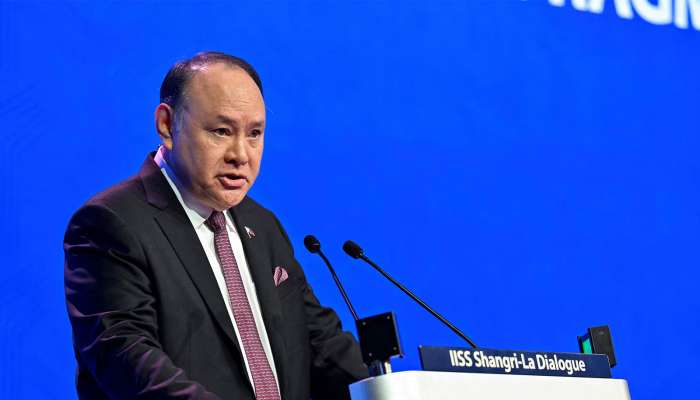
BANGKOK: China and the Philippines have exchanged sharp words over the South China Sea, with Beijing accusing Manila of “stirring up trouble” after Philippine Defense Secretary Gilberto Teodoro Jr. strongly criticised China’s maritime claims and actions in the disputed waters.
Speaking at the Seoul Defense Dialogue in South Korea on Tuesday, Teodoro reaffirmed the Philippines’ call for the 2016 international arbitration ruling on the South China Sea to be upheld.
During his remarks, Teodoro said he received a note, which he attributed to China, stating that Beijing “neither accepts nor recognizes” the arbitration ruling. After reading the message, Teodoro responded: “Of course, because you lost.”
He then accused China of showing disrespect for international law and the forum, telling the audience: “Have a little bit of decency, have a little bit of shame.”
Chinese representatives attended the Seoul Defense Dialogue, although they were not listed as panelists or speakers. It was not immediately clear who had delivered the note to Teodoro.
Asked about the incident in Beijing, Chinese Foreign Ministry spokesperson Mao Ning said she was not familiar with the “specific situation” but reiterated Beijing’s longstanding position on the arbitration case.
“We urge the relevant people in the Philippines to stop seeking attention and stirring up trouble and to cease undermining China-Philippines relations and stability in the South China Sea,” Mao told reporters.
The dispute centres on a 2016 ruling by an arbitration tribunal established under the United Nations Convention on the Law of the Sea. The tribunal ruled that China’s expansive claims in the South China Sea had no legal basis under international law.
China rejected the ruling and has continued to assert extensive claims over the strategically important waterway, which carries a significant share of global trade and remains one of Asia’s most persistent geopolitical flashpoints.
The Philippines initiated the arbitration proceedings in 2013, following a tense standoff with China the previous year over a disputed shoal. Beijing refused to participate in the proceedings.
Tensions between the two countries have continued despite efforts to manage their differences. The South China Sea is also contested by Vietnam, Malaysia, Brunei and Taiwan, with overlapping claims frequently leading to maritime confrontations.
In July, the Philippine military accused China's coast guard of injuring a Filipino sailor at a disputed shoal. According to Manila, Chinese coast guard personnel aboard a motorboat repeatedly struck the sailor on the head with a wooden baton, injuring him and damaging his smaller vessel.
China disputed the account, saying two rubber boats belonging to an “illegally” stationed Philippine vessel had rammed the Chinese boat.
Teodoro described such encounters as evidence that tensions had moved beyond what is commonly referred to as “gray-zone” activities.
“This is not gray zone anymore, this is actual coercion, bullying and aggression,” he said at the South Korean forum.
He also said he would keep the note he received as a “memento” of what he described as China’s desperation and the weakness of its position before an international audience.
The latest exchange comes amid renewed international attention to the South China Sea dispute. In July, the United States, Britain and more than a dozen other Western and Asian countries issued a joint statement reaffirming the legal significance of the 2016 arbitration ruling.
The continuing confrontation between Beijing and Manila is also being closely watched because of the Philippines’ growing security cooperation with the United States. The two countries are treaty allies, and repeated encounters between Philippine and Chinese vessels have raised concerns about the possibility of a wider confrontation.
The South China Sea remains strategically vital not only because of its competing territorial claims but also because of its shipping lanes, fishing grounds and potential energy resources. Its overlapping claims and frequent maritime encounters have made it a central test of regional security and the enforcement of international maritime law.