Saturday 04 / April / 2026
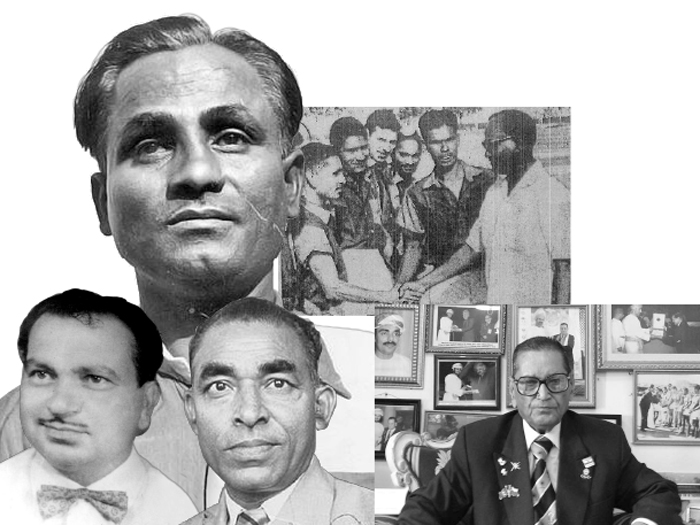
If there was ever a legendary sportsman produced by India, it was Dhyan Chand, popularly known as the “hockey wizard” all over the world for his prowess with the hockey stick on the field. Today, when fans talk about or watch hockey, one name will always come to mind — Chand’s.
Legends are born once in a blue moon and that goes for Chand who ruled the hockey world. Chand could be compared to the likes of Don Bradman, Jesse Owens, and Babe Ruth, who were incomparable in their own field of sport.
When Chand finished with hockey, he left behind a legacy of stars who went on to bring more laurels for India; his son Ashok Kumar who visited Oman as chief guest of the Dhyan Chand Day Hockey Festival was one such player who did him proud.
Years down the line, another hockey star appeared on the horizon in the form of SAS Naqvi, who was introduced to the hockey wizard who took him under his wing and groomed him to become a wonderful player.
Naqvi said, “I am the most fortunate player to have been in the company of the greatest hockey player to have played the game. It was an honour to associete with hockey legend, Dhyan Chand, and some of the other great legends such as Kishen Lal, K.D. Singh Babu, Balbir Singh and Leslie Claudius, who was the only player to win three Olympic gold medals and one silver,” he added.
“In 1951, Babu recommended me to Lal, who was the 1948 Olympic captain and was playing for then BBCI Indian Railways, now the Western Railways.”
He added, “It was in 1953 that the Dhyan Chand Memorial Hockey Tournament was held at the National Stadium in Delhi. I had the opportunity to play for Western Railways. It was during that tournament that I showed my skills with the stick, which were lauded by the press and later on Western Railways went on to win the coveted trophy, beating Kirkee United 3-0; it was such a joyous occasion for the team and me. After watching the game, Chand walked into the dressing room and said ‘today a star is born’ and that was the greatest compliment I have received and will cherish it all my life.”
“In 1960, I was selected for the Indian Railways training camp which was held in Calcutta and with Chand at the helm of affairs as the head coach of the Services team, and the Bengal squad in town, with all three teams preparing for the National championships, I got another chance to meet up with the legend. During the month-long camp I got to know Chand the person. A soft-spoken person, he shared his experiences as a player in the Olympics, as well as his last tour to East Africa in 1947,” said Naqvi.
“The most memorable moment was in 1973 when Chand had just retired as head coach of the National Institute of Sports Patiala, and I was invited to attend the felicitation ceremony at the same venue.”
Naqvi proudly said that Chand used to refer to him as “Maulana”.
Chand had a lot of respect for players such as Lal and Babu and other Olympians; he along with the other two were responsible for moulding Naqvi’s career and taught him the finer aspects of the game.
After playing hockey from 1949 to 1972, Naqvi took voluntary retirement from the game and was appointed assistant coach-cum-manager of the 1973 Indian Olympic team bound for Amsterdam and the Kuala Lumpur World Cup tour in 1975. On Chand’s recommendation, I joined the Netaji Subhas Chandra Bose National Institute of Sports (NIS) and to my great surprise, the Railway Sports Control Board nominated me in 1976 to join a batch of trainee coaches but by that time Dada Dhyan Chand had retired.”
“Later, I found out that Chand had recommended my name to the Railway Board for my nomination to NIS Patiala.”
Before laying his hockey stick down in 1972, Naqvi had already become a name to be reckoned with in India, having represented his state and country in a number of tournaments. Naqvi said he had been personally involved in grooming seven Olympians who had brought glory to India.
After his association with hockey in India and various legends of the game, Naqvi embarked on a trip to Oman in 1982 where he was appointed coach of the Omani National Hockey team.
“In 1982, Dawood Ahmed visited India, and had requested the Indian authorities to nominate a coach, who could coach the Omani national team for the Asian Games,” said the octogenarian, recalling that he was initially called only for two years.
When Naqvi landed on the shores of Oman, he realised that there was a big problem. “There was no Olympic Committee and without an Olympic Committee you can’t participate in the Olympics or the Asian Games.” He added, “Dr Hammad Ahmed Al Ghafri, who had taken over as president, nominated me to start the Olympic Committee and we opened a new office in Ruwi. And I was appointed the technical advisor from 1983 to 2003.”
He added, “That’s how my coaching career took off and I started a new and challenging journey that brought me to Oman, to serve the Sultanate first as the national hockey team coach and as the technical advisor of the Oman Olympic Committee.”
Till today, August 29 will always be etched in his memory not only because it is the birth anniversary of the greatest hockey player India has produced but for the lessons that Dhyan Chand had taught him and the legacy he left behind which we still see today — when the Indian hockey team beat Indonesia and Hong Kong by such huge margins — and last but not the least, the lessons he instilled in a generation of players who went on to achieve great heights.