Saturday 10 / January / 2026
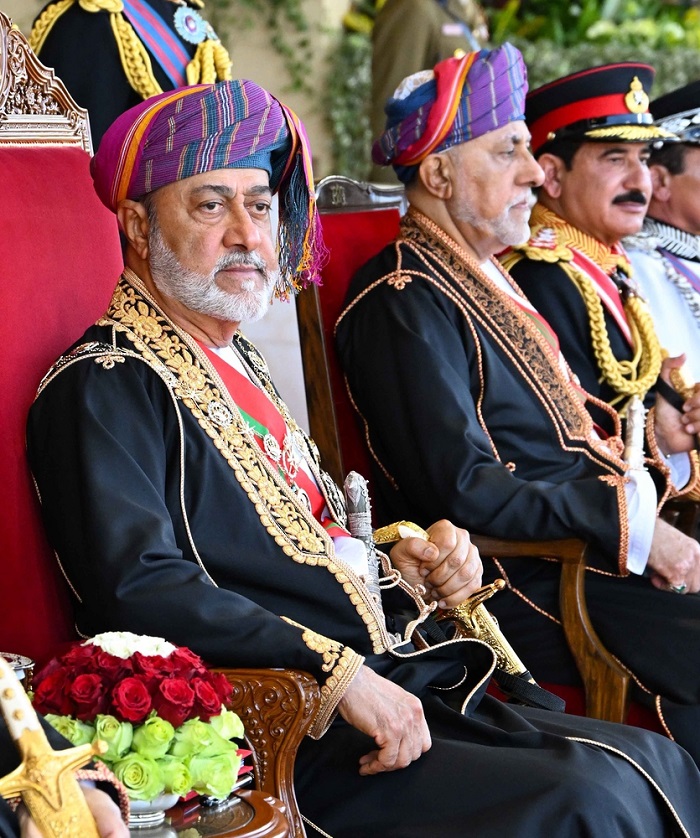
Muscat,: The Sultanate of Oman marks on Sunday, the anniversary of the accession of His Majesty Sultan Haitham bin Tarik , which falls annually on January 11. This cherished national occasion marks the continuation of Oman’s renewed renaissance, guided by a clear and ambitious vision founded on a comprehensive national framework that enhances future prospects with confidence and competence.
January 11 represents a moment of pride and honour for every Omani citizen and resident of this blessed land, and an occasion to renew loyalty and gratitude to the leader of the nation, and to continue giving in the spirit of “Renewed Renaissance Oman,” in order to build a promising future that future generations will be proud of—one in which aspirations and hopes are realized under the wise leadership of the beloved leader of the country, may God support him.
The Sultanate of Oman continues its journey through an advanced stage of responsible national work, based on consolidating the principles of good governance, promoting integrity and transparency, strengthening institutional roles, and laying solid foundations for sustainable development. This approach reflects steady progress toward achieving the objectives of Oman Vision 2040, enhancing the Sultanate’s standing and safeguarding its achievements.
Zahra bint Mohammed Redha Al Lawati, Deputy Head of the State Financial and Administrative Audit Institution for Oversight of Bodies, Investments and Companies, told the Oman News Agency that the lofty vision of His Majesty has contributed significantly to strengthening transparency and integrity within state institutions by consolidating the rule of law and affirming the principle of accountability without exception.
She added that Oman Vision 2040 supported empowering oversight bodies and enhancing their independence to protect public funds and ensure institutional integrity. It also helped spread a culture of disclosure and clarity in government work, strengthened public trust in state institutions, consolidated principles of good governance, modernized administrative systems, enhanced efficiency, and linked job responsibility to honesty and commitment—forming a sustainable reform approach that preserves the nation’s gains.
Her Excellency affirmed that the institution continues to enhance integrity by implementing its annual audit plans, receiving and reviewing public reports and complaints, and promoting transparency through the Integrity Enhancement Plan. It also consolidates governance principles in partnership with other government entities and engages society by publishing community summaries of its oversight work, in addition to organizing training programs within the framework of the Institutional Partnership Program.
She noted that Oman has achieved remarkable progress in the Corruption Perceptions Index issued by Transparency International, advancing 20 places in the 2024 ranking to 50th globally out of 180 countries and fourth among Arab states, compared to 70th in 2023. Oman’s score rose to 55, up from 43, reflecting the Sultanate’s commitment to international best practices in protecting public funds and promoting integrity.
Adel bin Al-Mirdas Al-Busaidi, Member of the State Council, said that since His Majesty the Sultan assumed leadership of the country, he has led a process of development and modernization that builds upon the achievements of the previous era, during which the foundations of the modern state and infrastructure were firmly established.
He added that Oman Vision 2040 constituted the cornerstone of the national roadmap toward comprehensive and sustainable development, with active participation from the Council of Oman through reviewing legislation, issuing recommendations, preparing specialized studies, and ensuring implementation in accordance with governance standards characterized by transparency and integrity.
He highlighted the importance of fiscal balance, economic diversification, increasing non-oil revenues, investment in renewable energy such as green hydrogen, and the Sultanate’s determination to achieve carbon neutrality by 2050. He also pointed to administrative restructuring, institutional integration, digital transformation, and the launch of electronic platforms that enhanced service efficiency and accessibility.
Mubarak bin Khamis Al Hamdani, Director of the National Office for Future Foresight at the Ministry of Economy, told ONA that His Majesty’s development philosophy is based on four pillars: establishing a solid foundation for sustainable development; enabling growth through legislative and institutional frameworks; managing development through indicators and effective follow-up; and achieving balance between economic growth and quality of life.
He explained that this philosophy was reflected in policies focusing on sustainable income generation, efficient spending, investment in promising sectors, diversified partnerships, and the establishment of an integrated social protection system based on fairness and accurate targeting.
He further noted that geographically balanced development has shifted from concept to practice through empowering governorates administratively and financially, reinforcing decentralization, and ensuring equitable access to development and services nationwide.
On the international level, Oman’s internal achievements are complemented by an active foreign policy rooted in respect for sovereignty, non-interference, peaceful coexistence, dialogue, and international cooperation. This approach has strengthened Oman’s reputation as a trusted mediator and responsible partner, supporting regional and international peace while aligning with the goals of Oman Vision 2040.
Throughout its history, Omani diplomacy has played a pivotal role in fostering dialogue, bridging differences, and promoting peaceful solutions, reinforcing international confidence in Oman’s balanced and credible approach.