Monday 09 / February / 2026
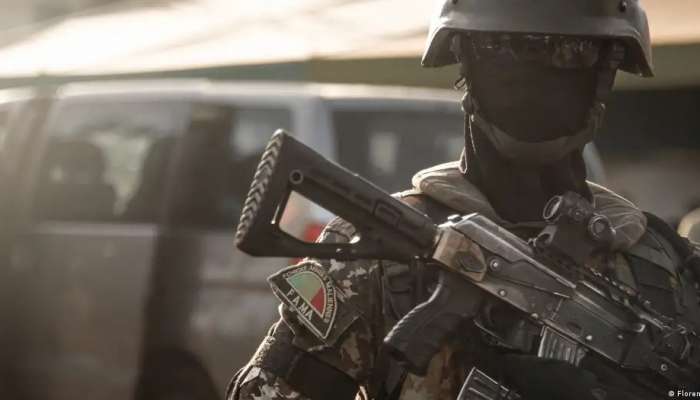
Bamako: Abdoulaye Diop, the foreign minister of Mali, hosted a senior US official on Monday to chart a "new course" in relations between the United States and the junta-led nation.
Nick Checker, who heads the US State Department's Bureau of African Affairs, reaffirmed Washington's respect for Mali's sovereignty.
Ahead of Checker's visit, the bureau posted on X that the United States also looked forward to "consulting with other governments in the region, including Burkina Faso and Niger, on shared security and economic interests."
From 2020 through 2023, the elected civilian presidents of Mali, Burkina Faso and Niger were overthrown in a series of coups, prompting the administration of Joe Biden, the president at the time, to restrict US military cooperation.
In October, Massad Boulos, the senior adviser for Arab and African affairs under the current US president, Donald Trump, told Le Monde newspaper that democracy is "appreciated," but it is no longer a criterion for ties.
Reed Brody, one of the lawyers for Niger's deposed president, Mohamed Bazoum, has criticized this stance.
"Unfortunately, it is not democracy or human rights that matter to Donald Trump's administration," he told DW. Bazoum, he said, "has been detained in the presidential palace for more than 900 days."
'Past policy missteps'
"It is clear that the Americans are not concerned about democracy in the Sahel right now," Ulf Laessing, the director of the Sahel program for the Konrad Adenauer Foundation, which is affiliated with Germany's ruling Christian Democrats. "They have adopted a pragmatic stance."
US officials say they want to correct "past policy missteps."
Mali, Niger and Burkina Faso had broken off or severely reduced relations with the former colonial power, France, and other Western partners –– and turned to Russia.
They also broke away from their West African neighbors in the ECOWAS regional bloc to form their own confederation, the Alliance of Sahel States (AES).
"We should welcome the fact that America is offering the AES countries, which France and the EU wanted to portray as pariahs, an opportunity for negotiation and discussion," Dr. Gnaka Lagoke, lecturer in history and Pan-African studies at Lincoln University in Pennsylvania, told DW.
"The second advantage is that this — whether in the debate between the West and the BRICS countries — always leaves African countries with a choice," Lagoke said.
"The US wants to use the tensions with the EU countries to pursue its own interests," Lagoke said, "which could benefit the AES countries."
Laessing said the military governments "enjoy a certain popularity –– at least among the very young population, who do not want to return to the old elites."
"People have it as their WhatsApp profile picture," Laessing said. "They see it as something they have achieved themselves. So it has created an identity."
Dissolution of political parties in Burkina Faso
In January, Burkina Faso's military-led government dissolved all political parties, analysts say changes little.
"The multitude of political groups has proven to be completely incompatible with the actual aspirations of the people and the strategic challenges, especially in the area of security," Interior Minister Emile Zerbo told DW.
All activities had already been banned for the parties since Burkina Faso's September 2022 coup.
Moussa Diaw, a political scientist at Gaston Berger University in Saint-Louis, Senegal, is not surprised by the move.
"Special regimes do not accept contradictions and do not tolerate political groups implementing their programs," he said. "Mali and Niger are following the same logic. It's an alibi."
Attacks in Niger and Mali
Mali has been in a security crisis since 2012. The military is fighting terrorist groups, primarily the West African branch of Islamic State (ISWAP) and the Al-Qaeda-linked Group for the Support of Islam and Muslims (JNIM).
The junta had promised to curb the insurgency, but attacks have continued despite those promises.
Checker's visit comes at a time when Russia is expanding its influence in the region, including by sending troops from its Africa Corps.
One example is January's attack on the airport in Niger's capital, Niamey, for which the ISWAP claimed responsibility.
"The African Corps of the Russian Defence Ministry and the Armed Forces of Niger jointly repelled the attack, neutralised about 20 terrorists and seized the attackers’ belongings and weapons," the Russian Foreign Ministry said in a statement.
Russia "will continue to make a constructive contribution to strengthening regional security, including assistance aiming to boost the combat readiness of national armed forces, by training service personnel and law enforcement officers," the statement added.
There was also a recent attack in Mali, in this case by the JNIM group.
At least 15 drivers were killed in an attack on a tanker convoy, sources told the AFP news agency. It was apparently punishment for the drivers bringing fuel to the capital Bamako despite an existing blockade. The JNIM wants to use the fuel blockade to force shortages and thus bring the economy of the landlocked country to collapse.
US eyes deeper Sahel role
"The United States sees how the jihadists are settling in the Sahel," a diplomat at the US Embassy in Bamako told the AFP news agency on condition of anonymity.
A Malian diplomat, who also spoke on condition of anonymity, said the US envoy had "come to make an offer of services to AES countries to see under what conditions the United States can get involved in the fight against jihadists in the Sahel."
The diplomat provided no further details.
The AES countries are rich in mineral resources: gold and lithium in Mali, uranium in Niger, gold in Burkina Faso.
Laessing indicated that Trump would likely want something in return.
"But can this be directly linked to anti-terrorism aid? According to the motto 'Give me your gold and you'll get weapons or satellite reconnaissance in return'? I don't think so," said Laessing, who noted that corruption and insecurity have kept US mining companies from the three countries.
What is the EU doing in the Sahel region?
The situation is "very complex," said Julian Bergmann, an expert on EU-Africa relations at the German Institute of Development and Sustainability (IDOS) in Bonn.
"Take Mali, for example: While France has withdrawn militarily from Mali, it is still present in terms of development policy," Bergmann said.
Other EU member states, including Germany, are also still involved in the Sahel region, he said, noting that Sweden, on the other hand, has withdrawn.
Bergmann said Brussels could only regain influence if it were to implement a common strategy. However, this requires the political will of all EU member states.
"And whether this is realistic given the current focus on security policy in Europe –– keyword Ukraine –– is not clear yet," Bergmann said.
"Unfortunately, Europe is in bad shape," Laessing said. "The major crises are taking place without the EU."
How influence in the Sahel will shift among global powers remains unclear.