Saturday 19 / September / 2026
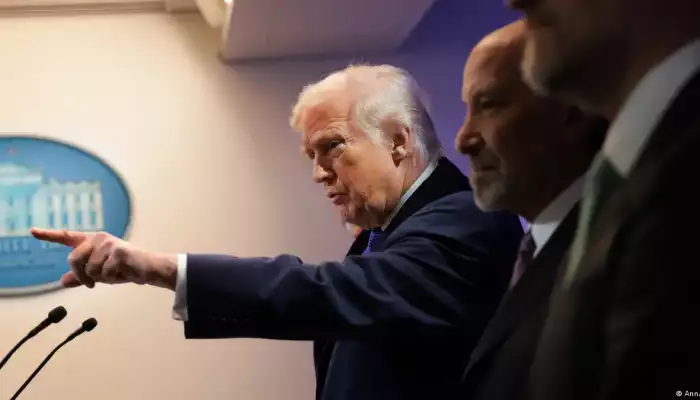
Donald Trump insists the new move to lift tariffs from 10% to 15% is "legally sound." DW asked ING Germany's Carsten Brzeski what's at stake for US businesses — and for European exporters.
Donald Trump said he would raise an across-the-board tariff to 15% from 10%, which he announced earlier on Friday. The change came less than 24 hours after a Supreme Court ruling struck down much of his earlier tariff plan.
The US Supreme Court ruling and Trump's reaction to it have prompted doubts on the validity of the 2025 US trade deal with the European Union, said Carsten Brzeski, chief economist at ING Germany.
Brzeski told DW that Trump's administration "has clearly been now damaged and weakened."
"I think that, in the end, Europe will probably try to play hardball now," he said. "So I assume that the Europeans will want to go either for a renegotiation or will try to lower their commitments in the deal."
EU-US trade deal in doubt after Supreme Court tariff ruling
The new import taxes issued by the US raise awkward questions regarding the trade framework agreed by Washington and Brussels last summer.
US President Donald Trump imposed heavy tariffs on multiple nations shortly after taking office in January 2025. In July that year, Trump threatened to impose a 30% trade penalty on EU goods — a drastic jump from 2.5% under his predecessor Joe Biden.
EU nations responded by scrambling for a trade deal with the Trump administration, eventually accepting tariffs of 15% on most of its exports to the US. The deal would also require the EU to buy $750 billion (€636.5 billion) of US liquified natural gas, oil, and nuclear energy products through 2028.
The terms, however, were controversial among EU lawmakers, and the recent Greenland crisis also prompted EU officials to briefly put them on hold.
Now that the Greenland row has eased, the process was set to move forward, and the European Parliament's trade committee was due to approve the deal on Tuesday.
On Saturday, however, the committee's chief Bernd Lange said the proposed deal lacked a legal basis, and floated the idea of the US government having to repay tariffs collected since Trump's return.
China has overtaken the US to become Germany's biggest trading partner, according to the latest official data.
Bilateral trade between China and Germany was €251.8 billion ($296.6 billion) in 2025, compared with €240.5 billion with the US.
In a report published on Friday, Germany's Federal Statistics Office noted a 5% drop in US trade compared to 2024, when the US held the dominant position.
Germany, the EU's largest economy and exporter, was forced to navigate multiple trade obstacles imposed by the Trump administration at various points in 2025.
EU readies tariff stance before Merz goes to Washington
German Chancellor Friedrich Merz said he would present Donald Trump with a "very clear European position" during his visit to the US in early March.
Speaking to state broadcaster ARD, Merz said EU member states will coordinate with each other in the coming days to formulate a unified policy.
"Tariffs are a matter for the European Union, not the individual member states," said the German leader.
The wealthy European bloc, comprised mostly of US allies, has suffered numerous trade shocks since Trump's return to office in early 2025.
On Saturday, chairman of the European Parliament's trade committee Bernd Lange said there was a realistic chance for the US trade penalties to be repaid.
Lange, a German politician, was commenting on the Supreme Court decision that struck down many of Trump's tariffs.
Speaking to public radio "Deutschlandfunk," Lange estimated that German exporters and their US partners may have overpaid by over €100 billion ($118 billion).
The EU official also said he was set to convene a special meeting of European Parliament's negotiators and legal advisers for Monday, saying that the US-EU trade deal the bloc was trying to implement now lacked legal ground.