Tuesday 25 / August / 2026
Muscat: Muscat Governorate marked the Arab Cities Day yesterday, Sunday 15 March, which commemorates the founding of the Arab Towns Organisation in Kuwait City in 1967. The theme for this year is “Cohesive Arab Cities in the Face of Challenges.”
In his address for the occasion, the Secretary-General of the organisation, Badr Wael AlAjil, stated that Arab cities play a central role in strengthening the resilience of communities in the face of economic, environmental and social challenges, as well as the pressures of urban growth and climate change.
He emphasised the importance of building cities that are capable of adapting and managing crises, particularly as some cities require reconstruction.
This can be achieved through urban development, stronger governance, the use of modern technologies, and expanding partnerships between the public and private sectors as well as civil society.
Since joining the Arab Towns Organisation in 1971, Muscat Governorate has been keen to play an active role in the organisation’s work.
This participation has enabled the governorate to exchange expertise and experiences with other member cities in areas such as city design, urban development and municipal services, while also benefiting from best practices in sustainable urban planning.
The governorate’s commitment to urban planning and development is reflected in a number of major projects implemented across Muscat to improve quality of life and manage urban growth. These initiatives include preserving architectural identity, establishing public parks and green spaces, developing waterfront areas, and upgrading roads and basic infrastructure.
One prominent example is Sultan Haitham City, one of the most significant modern urban projects in the governorate. It is a contemporary city planned according to modern smart and sustainable city concepts.
The development includes integrated residential neighbourhoods, educational and commercial services, and extensive green spaces.
It represents a model for sustainable smart cities in Muscat, designed to provide essential services within short distances that encourage walking, while its urban layout supports different transport options and allows natural airflow between buildings.
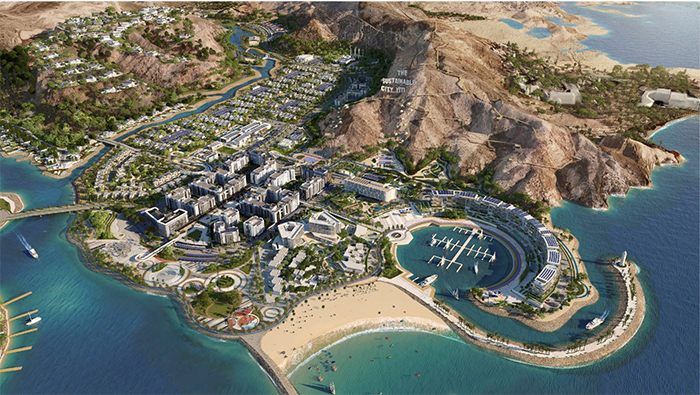
Alongside Sultan Haitham City, Muscat Governorate is also home to the Yiti Sustainable City project. The development includes 1,657 residential units, among them 300 environmentally friendly villas. The project relies on renewable energy and electric vehicles, with charging stations available, making it an advanced model of sustainable and technology-driven urban development.
It is worth noting that the Arab Towns Organisation was established to achieve several key objectives, most importantly strengthening cooperation between Arab municipalities, exchanging expertise in city management, and discussing shared challenges such as population growth, transport, the environment and waste management.
These issues have become increasingly pressing in light of global challenges such as climate change and urban expansion, which require cities to adopt more flexible and resilient planning approaches.