Wednesday 01 / April / 2026
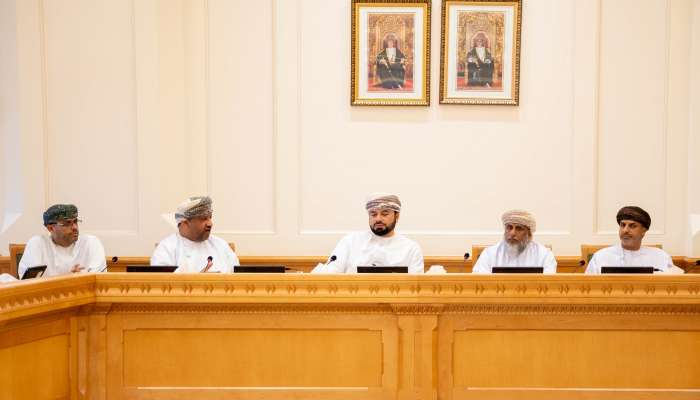
Muscat: The Food and Water Security Committee of the Shura Council held its fifth regular meeting of the third annual sitting (2025–2026) of the tenth term on Wednesday.
During the meeting, the committee hosted specialists from Sultan Qaboos University, represented by the College of Agricultural and Marine Sciences, to discuss a proposal on “Future Agricultural Cities: Opportunities and Challenges.”
The committee is currently studying this topic to identify the key challenges facing such cities and explore ways to develop them in a manner that supports sustainable food security and economic diversification in line with Oman Vision 2040.
The meeting, Professor Rashid Abdullah Al Yahyaei, Dean of the College of Agricultural and Marine Sciences at Sultan Qaboos University, delivered a visual presentation highlighting the college’s academic programmes and departments, as well as its efforts in advancing agricultural research and utilising the latest artificial intelligence technologies.
The presentation also addressed prominent research in smart agriculture and sustainability, along with considerations of environmental and climatic characteristics specific to Oman in the planning of such cities.
The meeting further explored optimal institutional models to enhance integration between universities, government entities, and the private sector in implementing large-scale agricultural projects.
Discussions also covered the role of Sultan Qaboos University as a national hub for research and development within this initiative, in addition to proposed mechanisms to ensure the sustainability of partnerships between academic institutions and investment entities.
Participants also reviewed key initiatives and ongoing research projects in plant sciences and agricultural engineering, particularly those related to precision agriculture and resource management.
The potential application of these research outcomes in supporting the design and implementation of future agricultural cities in the Sultanate of Oman was highlighted.
Committee members emphasissed the importance of focusing such projects on critical issues, including water and energy efficiency in arid environments, in alignment with Oman’s climatic and geographical conditions.
Committee members also inquired about the technological readiness of current research outputs in this field and the challenges associated with transitioning research from laboratory stages to practical, real-world applications.
They questioned whether the university has business incubators or accelerators capable of supporting the transformation of agricultural innovations into startups—an effort that would help align scientific research outputs with comprehensive development plans and the objectives of Oman Vision 2040.
The meeting focused on the main challenges and proposed solutions to strengthen integration between research and investment, as well as the importance of aligning scientific outputs with the needs of investors in the agricultural sector and identifying practical tools to build trust between researchers and investors.
On another note, the committee also reviewed the draft unified law (regulation) for the management of plant genetic resources for food and agriculture within the Gulf Cooperation Council, which was referred by the government.
The meeting was chaired by Abdullah Ahmed Al Malek Al Shuhi, Head of the Committee, and attended by committee members.
It concluded with an emphasis on the importance of establishing an integrated national ecosystem linking scientific research, practical application, and investment in the field of future agricultural cities.