Monday 04 / May / 2026
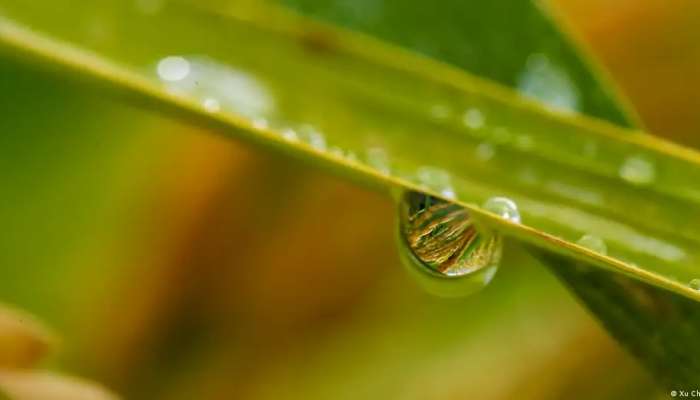
Massachusetts: While the gentle patter of rain is a relaxing sound for most of us, the same sound could provide an alarm for seeds waiting to germinate.
Plants are known to respond to a range of environmental cues. Some react to touch, others to chemicals, and most to light. The idea of gravity-sensing is also well established.
Now, researchers at the Massachusetts Institute of Technology (MIT) in the United States have found that some seeds respond directly to the sound of falling rain by germinating faster.
In fact, it is as if seeds use the environmental cue of rainfall — feeling or hearing it through the vibrations it produces — to decide, as it were, it is the right time to grow.
How seeds respond to rainfall and germinate
The researchers at MIT ran tests with rice seeds. They found that acoustic vibrations from raindrops shook the seeds out of dormancy and triggered them to sprout sooner than they otherwise would.
Their findings have been published in the journal Scientific Reports.
They offer the first direct evidence that plant seeds can sense sound and act on it.
The researchers exposed thousands of rice seeds to controlled droplets of water, mimicking rainfall of varying intensity, from light to heavy. The seeds were submerged in shallow water — conditions typical for rice cultivation.
And the results were striking. Seeds exposed to the sound of falling droplets germinated 30-40% faster than seeds kept in silence.
It all comes down to physics. When a raindrop hits water or soil, the pressure it causes creates vibrations — or "pressure waves" — that travel through the medium and can be picked up as sound.
In water, the vibrations can be particularly intense.
MIT's Nicholas Makris, who co-authored the study with colleague Cadine Navarro, has compared pressure waves picked up by seeds, just a few centimeters from a raindrop's impact, as "comparable to [the sound a person hears] a few meters from a jet engine in air."
The term "hearing" suggests that there is a part of the plant that is "listening" and acting on what it "hears" in a cognitive manner. And there is an element of truth to the idea.
Frantisek Baluska, professor emeritus in plant physiology and plant cell biology at the University of Bonn, who was not part of the MIT research, points to other research that suggests plant seeds may have so-called decision centers. These decision centers are sometimes described as miniature "plant brains".
"We know that plants are truly living organisms," said Baluska. "Plants are emerging as cognitive organisms."
As with the idea of plants hearing rain, plants do not think as we, humans, would think of "thinking".
But it is possible, said Baluska, that seeds decide about seed germination based on a form of "cognitive evaluation."
The role of gravity-sensing cells in seed germination
Makris and Navarro believe that these vibrations act on tiny internal structures known as statoliths. These are dense, sand-like organelles inside plant cells that help detect gravity.
Statoliths settle at the bottom of cells, from where they allow a seed to know which way is up and which is down — so, roots grow downward and stems grow upward.
But the team's research suggests that the energy from rain-induced vibrations disrupt the normal function of statoliths.
"When the seed is shaken by an acoustic wave, the statocyte [gravity-sensing] cell is shaken, and statoliths inside the cell are displaced, just like salt in a salt shaker," Makris told DW. "This disruption can cause a growth response."
Sensing rain gives seeds an advantage to survive
Seeds that respond to these vibrations are likely to be close to the surface — where moisture is available, but not so deep that emerging shoots cannot reach the light.
That means that the sound of rain may help them judge whether they are in an ideal position to grow.
"Human hearing is adapted to be advantageous to humans," said Makris. "What we found the plant seeds and seedlings are doing is apparently advantageous to them as well."
Makris said it was likely that seeds from other plants respond to the sound of rain in a similar way.