Wednesday 20 / May / 2026
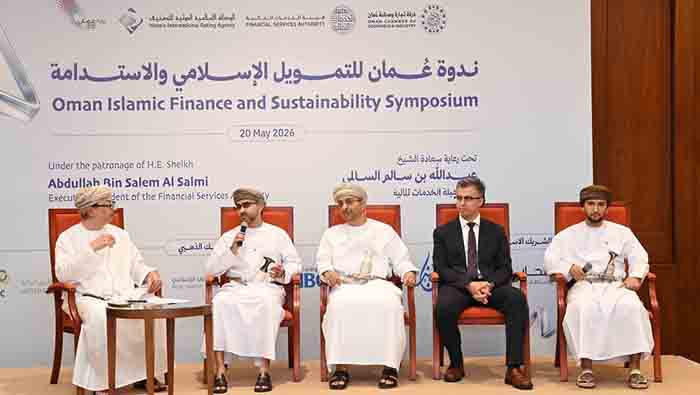
Muscat: Oman Islamic Finance and Sustainability Symposium, organized today by Oman Chamber of Commerce and Industry (OCCI), emphasised utilising banking and financing tools and enhancing the alignment of practices with the targets of Oman Vision 2040.
The opening ceremony was held under the auspices of Abdullah Salim Al Salmi, Chairman of the Financial Services Authority, who explained that Islamic finance and sustainability are two sides of the same coin. He noted that Islamic finance is inherently closer to sustainability due to its consideration of society, the environment, governance, and projects, pointing out that there must be independent offices to conduct Sharia auditing to verify that a product is compliant with Islamic Sharia.
Faisal Abdullah Al Rowas, Chairman of the Board of Directors of Oman Chamber of Commerce and Industry, confirmed that organising the Islamic Finance and Sustainability symposium comes within the framework of the Chamber's keenness to support specialised economic dialogues that keep pace with global transformations in the financial sector. He added that this role enhances the contribution of Islamic finance to supporting sustainable development paths and stimulating investment, in line with the objectives of Oman Vision 2040.
He added that the seminar reviewed international best practices and experiences, while working to enhance partnerships among financial institutions, the private sector, and regulatory authorities. This supports the building of a more resilient financial ecosystem capable of attracting qualitative investments and supporting promising economic sectors, especially those related to clean energy, the green economy, and innovation.
Mustafa Ahmed Salman, Board Member of Oman Chamber of Commerce and Industry and Chairman of the Finance and Insurance Committee at the Chamber, stated that Islamic banking has successfully strengthened its presence regionally and internationally over the past years, not only as a specialised financial sector, but as a key partner in supporting economic development, stimulating investment, and enhancing financial inclusion. This is in addition to its role in directing financing toward productive sectors and projects with a sustainable developmental impact.
He pointed out that the Sultanate of Oman, under the targets of Oman Vision 2040, is moving toward building a diversified and sustainable economy based on innovation, knowledge, and investment in future sectors, foremost of which are clean energy and the green economy. He emphasised that developing sustainable financing tools, including green sukuk and sustainability-linked financing, represents one of the important enablers to support these national trends and attract qualitative investments.
He stressed that enhancing integration between the principles of Islamic finance and sustainability requirements opens broad horizons for the financial sector to develop innovative products and solutions capable of keeping pace with global changes, enhancing the competitiveness of financial markets, and raising the efficiency of the business environment. This contributes to consolidating the Sultanate of Oman’s position as a promising regional hub in the fields of Islamic finance and sustainable investment.
For his part, Faheem Ahmad, Head of the Islamic International Rating Agency in the Kingdom of Bahrain and the Sultanate of Oman, said that Islamic finance today possesses a real opportunity to transition from its traditional role as a source of funding to a key partner in achieving sustainable development goals, through its core principles based on justice, transparency, and linking finance to the real economy. He noted that the Sultanate of Oman possesses promising capabilities to enhance its position as a regional hub in this field, given its ongoing legislative and regulatory development and growing interest in sustainability.
He asserted that building a supportive ecosystem for sustainable finance requires the integration of roles among financial institutions, regulatory authorities, and rating agencies, which enhances levels of trust and transparency and stimulates the flow of qualitative investments. He emphasised the importance of adopting clear standards for disclosure and sustainability to keep pace with international best practices and enhance the competitiveness of Islamic financial markets.
Dr. Damir Galiev, CEO of the Investment and Venture Capital Fund of the Republic of Tatarstan, stated that sustainable investment is no longer an option but has become an economic and developmental necessity. This requires the development of flexible and innovative financing tools capable of supporting business owners and future projects, while highlighting the importance of benefiting from international experiences and exchanging expertise in the fields of finance, sustainability, and innovation.
The event’s discussions emphasised the importance of continuing dialogue between the public and private sectors to develop a sustainable financing environment and to reinforce the role of Islamic finance as a supportive tool for economic diversification and achieving balanced development, keeping pace with global transformations and boosting the competitiveness of the national economy.
On the sidelines of the seminar, several memorandums of understanding (MoUs) related to future cooperation and partnerships were signed. An MoU was signed between the Investment and Venture Capital Fund of the Republic of Tatarstan and the Islamic International Rating Agency, aiming to enhance cooperation in the fields of investment, credit rating, and Islamic finance, and to develop partnerships of mutual interest between the two sides.
Additionally, an MoU was signed between Pan Asia Advisory in the Kingdom of Bahrain and the Investment and Venture Capital Fund of the Republic of Tatarstan, with the objective of enhancing cooperation in the fields of investment advisory, Islamic finance, advisory services, and developing investment opportunities of mutual interest between both sides.
Furthermore, an MoU was signed between the Islamic International Rating Agency and Sohar Islamic Bank, aiming to enhance cooperation in the areas of Islamic finance, credit rating, and Sharia-compliant financial services, thereby contributing to supporting the development of the Islamic financial sector and enhancing joint cooperation opportunities between the two parties.