Wednesday 07 / October / 2026
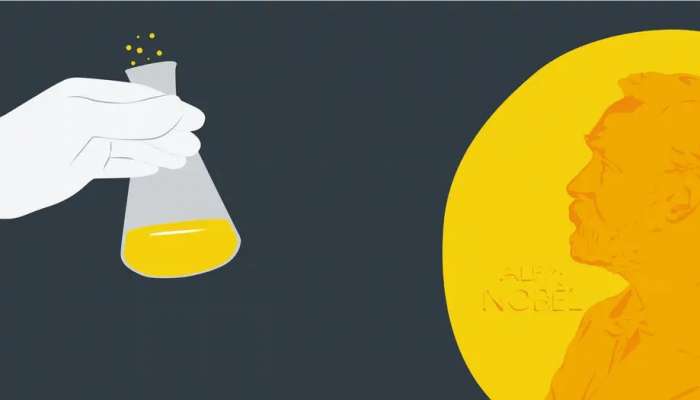
Stockholm: The Nobel Prize in Chemistry on Wednesday was awarded to Henri B. Kagan and Kenso Soai "for the discovery of non-linear effects and autocatalysis in asymmetric organic synthesis."
Last year, Susumu Kitagawa, Richard Robson and Omar Yaghi won the Nobel Prize in chemistry for the development of new molecular structures that can trap vast quantities of gas inside. Their discoveries can help tackle some of the world's most pressing problems, like climate change.
What do laureates receive?
Laureates receive a tailored diploma, a medal and a document detailing the cash award that is set this year to 12 million Swedish kronor, which is equivalent to just over €1 million or $1.2 million.
The Nobel Prize in medicine was awarded Monday to Karl Deisseroth, Peter Hegemann and Georg Nagel for their pioneering work on optogenetics, a method of controlling nerve cells with light, which makes it possible to study how the brain works.
The Nobel Prize in physics was awarded Tuesday to Francis Halzen, a Belgian-born astrophysicist whose efforts helped demistify a rare group of neutrinos that launched a new era of astronomy.
Nobel prizes in literature and peace also this week.
The Nobel Prize in literature is set to be awarded on Thursday and the Nobel peace prize will be announced on Friday.
After that, the Nobel Memorial Prize in Economic Sciences will be announced on Monday.
All prize announcements are streamed live by the Nobel Prize organisation.